 5a33a6b97a
This GC wraps Eval() to create a copy of the result, and then memcpy's it backwards to the position where the g_mem pointer resided at the beginning of Eval() thereby discarding all the cons cells that got created which weren't part of the result. Overlap (or negative GC) isn't possible because we don't copy cells beneath the low water mark. As it turns out 44 bytes is all you need to implement garbage collection when your language guarantees that data structures can't have cycles, due to the lack of mutability. |
||
|---|---|---|
| bin | ||
| test | ||
| .gitignore | ||
| bestline.c | ||
| bestline.h | ||
| LICENSE | ||
| lisp.c | ||
| lisp.lisp | ||
| Makefile | ||
| README.md | ||
| sectorlisp.S | ||
sectorlisp
sectorlisp is a 512-byte implementation of LISP that's able to bootstrap John McCarthy's meta-circular evaluator on bare metal.
Overview
LISP has been described as the Maxwell's equations of
software.
Yet there's been very little focus to date on reducing these equations
to their simplest possible form. Even the original LISP
paper
from the 1960's defines LISP with nonessential elements, e.g. LABEL.
This project aims to solve that by doing three things:
-
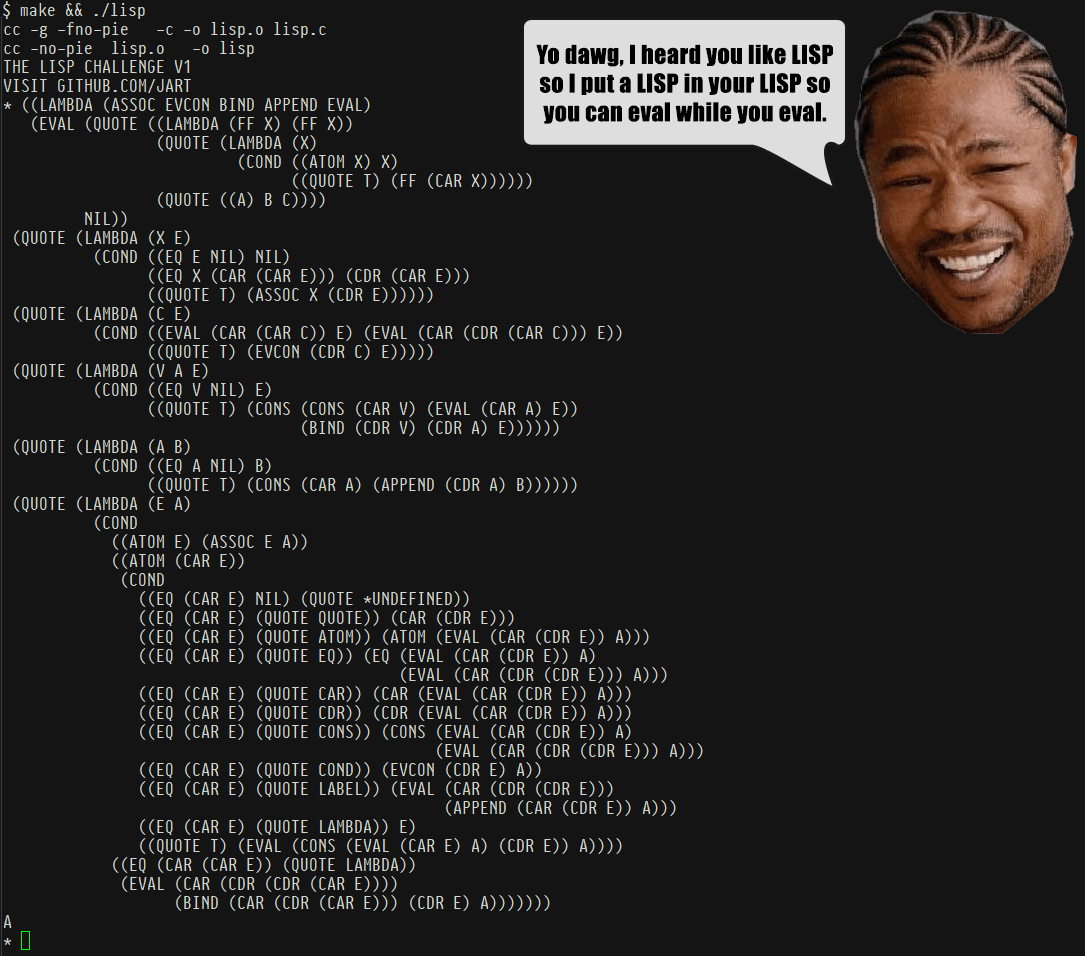
We provide a LISP implementation that's written in LISP, as a single pure expression, using only the essential functions of the language. See lisp.lisp. It's the same meta-circular evaluator in John McCarthy's paper from the 1960's, except with its bugs fixed, dependencies included, and syntactic sugar removed.
-
We provide a readable portable C reference implementation to show how the meta-circular evaluator can be natively bootstrapped on POSIX conforming platforms, with a pleasant readline-like interface. See lisp.c.
-
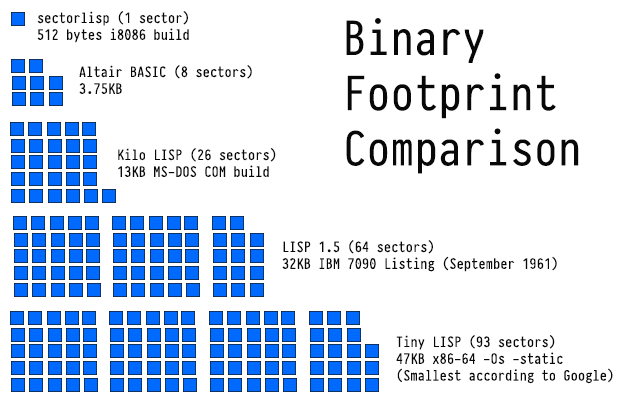
We provide a 512-byte i8086 implementation of LISP that boots from BIOS on personal computers. See sectorlisp.S. To the best of our knowledge, this is the tiniest true LISP implementation to date.
Getting Started
See lisp.lisp for code examples that you can copy and paste into your LISP REPL.
You can run the C implementation as follows:
$ make
$ ./lisp
After running make you should see a sectorlisp.bin file, which is a
master boot record you can put on a flopy disk and boot from BIOS. If
you would prefer to run it in an emulator, we recommend using
Das Blinkenlights.
curl --compressed https://justine.lol/blinkenlights/blinkenlights-latest.com >blinkenlights.com
chmod +x blinkenlights.com
./blinkenlights.com -rt sectorlisp.bin
Alternatively you may use QEMU as follows:
qemu-system-i386 -nographic -fda sectorlisp.bin
Further information may be found on our wiki.
Demo
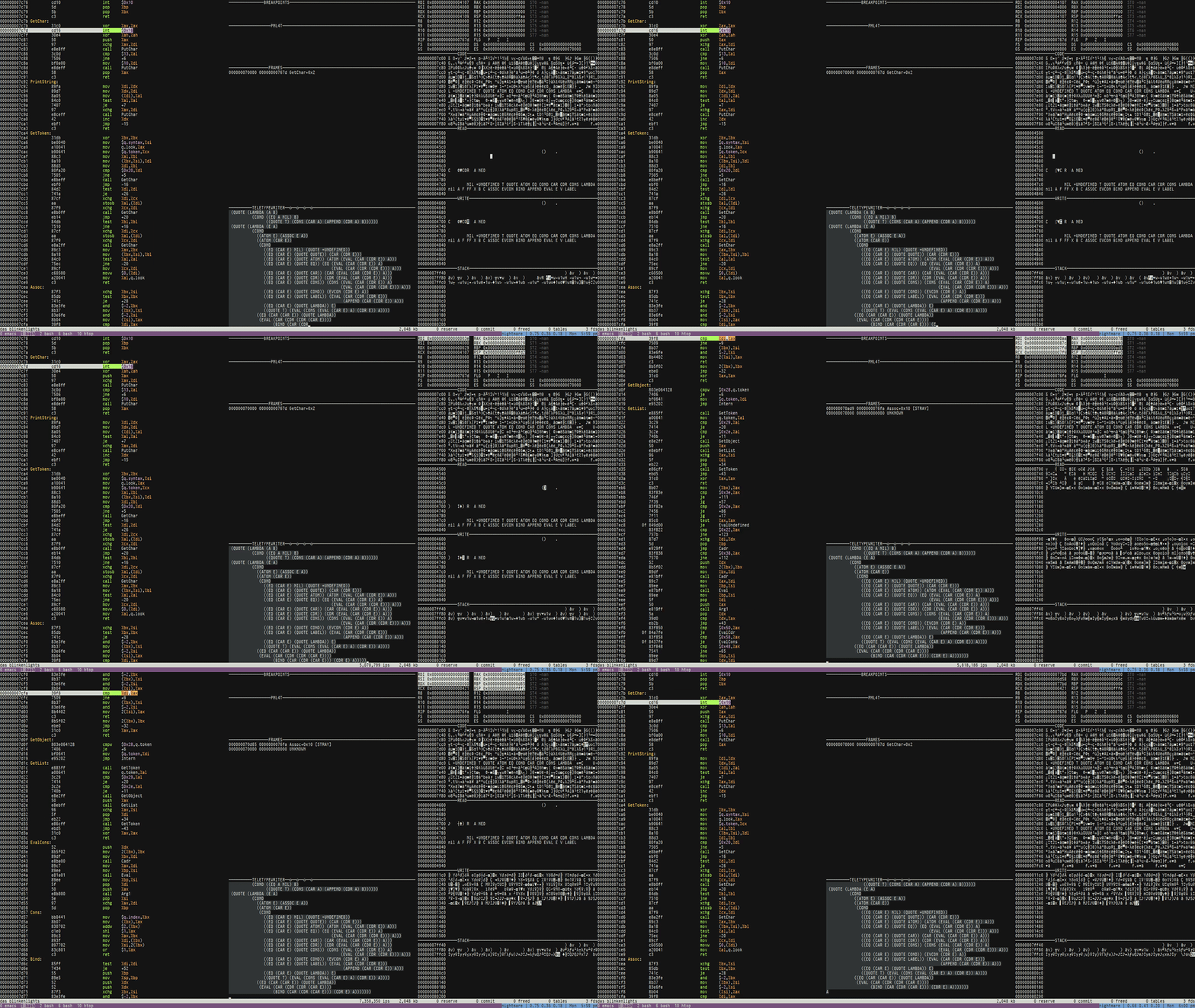
The video above demonstrates how to boot sectorlisp in the blinkenlights emulator, to bootstrap the meta-circular evaluator, which evaluates a program for finding the first element in a tree.
You can watch the full demo on YouTube.